Thursday, September 25, 2008

Week 4: Basketball, pineapple rice and decisions, decisions. .


My schedule is continuing on. 8 AM Chinese class, "ting-xie"s (character tests were the Laoshi/Teacher tells us a word and we have to write it correctly), readings in Chinese, taiji class, more Chinese. Then one and a half hour lunch break. Lectures with Kunming experts on a variety of subjects. We had a great one the other day on the Chinese economy and the speaker was very realistic in recognizing China's unprecedented growth, but then also reminding us that considering China's 1.3 billion person population, the per capita income is still very low, the income gap is increasing, and they are still transitioning from an agrarian society to an industrial society, and even farther away from the transition to a service-based economy. Another day was a women who talked about the HIV/Aids situation in China. Yunnan Province especially, because of its proximity to the Golden Triangle, has some of the highest numbers of HIV/Aids and drug addicts.

However, it appears (we could be being fooled), but it appears that, in Yunnan at least, the government is doing something to help the drug addicts and HIV/Aids patients. On Wednesday we took a day off from Chinese. (Thank goodness, because otherwise we would have had SEVEN days in a row of Chinese classes, and honestly, my mind just can't handle that).


So, on Wednesday, we went to the edge of Kunming and visited the Kunming Drug Rehabilitation Center. In retrospect, I think we received the business/investors tour that focused on this center's crown jewel: The "Peace Village." This is set up to house patients that have gone through the rehabilitation process, as a half-way town to help increase the chances that the recovered addict stays clean back in the "real world." Everything that we saw was very neat and clean. Apparently, this clinic even invented their own drug to assist rehabilitation- a Chinese, traditional herbal methadone of sorts called, "6.26". I only remember this because they treated us to a very nice show in the little in-center theater. We saw two traditional dances and a flute/poem number, with the advertisement for 6.26 as the stage backdrop.

Then after we finished the tour came the best part: we played basketball with some of the people living there. (Let's just emphasize for comedic effect that this is former drug addicts playing western college students (mostly female, seeing as in our study abroad group there are only 3 guys and 10 girls.. . .) For the sake of international peace and the continued friendly relations of our respective countries. . the game ended in a tie.


Stone Forest - Stone Structure Near "Forest" Entrance

Last Sunday was also a big excursion. We group went to one of THE Yunnan tourist attractions: the Stone Forest. It was beautiful. Very touristy. But definitely something that we had to go and see and it was totally worth the trip out there. We didn't really get to see that much of it, but impressive stones all start looking alike after a while. . . And the weather was absolutely beautiful for the day, and I finally had a camera again! so all was well. (Even if the woman at the snack stand did charge me 3 yuan for only one orange when I can usually get a half a kilo for that price. . . Yep, i suppose China's gotten to me considering I was annoyed, even thought the touristy inflated price that orange still cost me less than it would in DC.)


"Elephant on Platform"

So the latest thing now (besides the fact that we found a new, DELICIOUS Indian restaurant- we've all hit our monthly quota of Chinese food. . .) is that next week is our "Yunnan Exploration Excursion." This is kinda a big deal because it involves us, in small groups or on our own, picking a location that we want to travel to, buying the tickets, figuring out where we want to stay and what we want to do and then making it back alive by 2:30 on Monday the 5th. So far even picking the location has been hard. My only criteria was that I wanted to go south. A popular southern destination is called Xishengbanna, home to the Dai minority, elephants, and lots of pineapple rice (absolutely delicious sticky, sweet rice with pineapple that's then served in a pineapple). However, the other place we're considering is a remote location in far southeast Yunnan, a little village that can only be reached by boat through a limestone tunnel, called Bamei. Its a touch decision. . .
[Editor's note: The night before we had to buy our bus tickets we flipped a coin, and the coin decided we were going to go to Bamei. Unfortunately, Courtney and Courtney still want to go see the elephants so just Justin and I will be venturing to Bamei and then to Yuanyang to see the terraced rice fields. Buying the bus tickets was yet another interesting time. . . .]
Its also important because once we embark on this "excursion" its kinda the end of the first segment of our study abroad experience. From here on out we essentially become nomads. During this first month, we've settled here in Kunming, fallen into patterns, what restaurants we go to on what days, where to get the 10 kuai manicures, etc. but now we're venturing off. (And we're venturing off during the "Golden Week," a "brilliant" Chinese concept in which most of the country has the week off . . . meaning that EVERYONE and their Chinese brother, cousin and aunt, are all traveling in this same week's time. Like i said, brilliant.


I suppose its a good thing I haven't made a habit of posting on a schedule. I don't know when I'll have the constant internet access that I've head thus far, but hopefully the posts won't get even more sporadic.

Sunday, September 14, 2008

中秋快乐!Happy Mid-Autumn Festival

中秋快乐! (zhongqiu kuaile)
So today is the Mid-Autumn festival in China. It’s one of the three major holidays in China. (The other two being Dragon Boat festival and the Chinese New Year). http://en.wikipedia.org/wiki/Mid-autumn_festival We don’t really know exactly what’s the deal with the festival- other then the legends behind its celebration and that we were tired of moon cakes before the day even started. Moon cakes are the Mid-Autumn festival 'treat,' though I haven’t found them to be overly appetizing. As with most Chinese treats, they normally find 'different' flavors appealing. Red bean is a common 'sweet' flavor, or the especially 'delicious' 'cakes' contain cured meat, or an egg yolk with meat, coconut, lotus. . . (I couldn’t even try the egg yolk ones, especially after my roommate, Kara, took one bite, spit it out and had to go out to buy a bar of Dove chocolate (the only kind that is available in China) to get the taste out of her mouth.


This is a picture of the few remaining "Bound foot Women" (Lao Tai Tai) in Tonghai. (Our orientation destination.) Some of the women's feet are only 3 INCHES!! long.


[Disclaimer: This is probably going to be a long recap- I’ve been horrible at keeping up with blogging/journaling. ]


Temple outside of Tonghai, China


HISTORY AND RELIGIONS
As you’ll see from what shall be a long entry, our first seminar is 'History and Religions,' meaning that most of our lectures, readings and field trips are related to China’s history and the major religions of Buddhism, Daoism, Islam and Christianity. I have now seen many a Buddist/Daoist temple, just the other day we went to a Hui mosque, (Hui is the minority name for most Muslims in China. It is rather interesting to see the Muslim population here- they’re very integrated into society, some women wear a head scarves, but many choose not too, all universities are required to have a Muslim cafeteria that doesn’t serve pork, and it’s the only minority grouping in China based on religion. Its also just cool to see some parts of China with signs in Chinese and Arabic- its like doubly illegible to me.) And today we went to visit the Miao people who live in a relatively remote village (think dirt roads winding and winding up a mountain, but its only about an hour and a half from Kunming) and were converted to Christianity by German missionaries. I had been looking forward to this because after all the temple visits I realized I wasn’t really as religiously aware/open minded as I thought. I just had a hard time grasping the concepts of Enlightenment and THE Buddha, versus living Buddas, since it was outside my monotheistic traditions. (It was just the flip side, like if you haven’t heard of Christian ideas and then you are told biblical stories, they sound a bit odd at first.)
Ever since going to Guatemala and seeing a small room in someone’s house that had been lovingly decorated and set up as a chapel, I think churches in developing countries are very interesting. This one was no different – I’d never heard a service in Chinese before, men sat on the pews on one side, women and children sat on the other. There were sparse decorations on the wall, no alter, but there was a very large flat screen television. In fact, everyone in the village had a television! Apparently, the village choirs were so good that they competed in music competitions in Beijing and around the world and so the government rewarded the village by giving every family a tv! This remains a small rural village, with simple conditions- however- every household has a tv. Oh China. . .


TEMPLES. . Temples. . .and more temples. . .
Quick run through of the temples- We went to one in Tonghai during our orientation- highlight of that one was the delicious vegan meal (see food blog entry). Another was outside of Tonghai that was very beautiful. All of these have been really nice to go to in that I really don’t think many other Westerners ever go to these temples as tourists.


Men Playing Mahjong? in a Confucian Temple


ADVENTURES
The third temple that I went to was called Qiongzhu Si (Bamboo temple) as part of our 'Kunming' drop-off.
SIT (the study abroad company that this trip is run by) has a very unique format among study abroad programs, and they are especially proud of this idea of the 'drop-off.' The idea is to prepare us for the independent travel we’ll be doing for the last month of the program. Our 'drop-off' assignment (our- being myself, Tal, and Joe, other SIT group members) was written in characters on a piece of paper and we were given 150 yuan and told to be back by 4pm. Unfortunately, we couldn’t figure out what the characters were (mostly because the first person we asked on the street told us the wrong pinyin for the first character) so when we got to our dorms to try and figure it out with our dictionaries and our online dictionaries we had yet to figure out where we were supposed to go. (We knew it was something Bamboo temple, but we had no idea where or how to get there. In a strange twist of 'resource utilization' I asked James in the US, if in his intense researching on Kunming, he had seen anything about a Bamboo temple. Ten seconds later. . he’s found a link with info about the place and pictures of it, which confirmed the characters. . .[J-Thanks again ☺] ) Finally knowing where we were going we asked our building guard if he knew how to get there- he did and we recommended the bus as our best option. From our limited understanding of his directions, we thought that he had said we could take bus X to stop Y and get off and change buses to get there. But no. We get off the bus at the right stop and are immediately accosted by little women talking about the temple and taxis to get there (we realize this in retrospect). But they’re unofficial taxis and we have no idea how much farther away the temple is and we’re confused. Hesitant, we hail an official taxi- but he wants to charge us 2X as much! Fifty yuan! So we ended up trying out luck with the 25 kuai (the colloquial word for yuan or renmenbi) unofficial taxi. It turned out to be the right thing – the taxi took us out of the city and up Yu’an mountain right to the temple. The temple was just another temple, we had a good vegan food, really good tea, but it was really the adventure of getting there and back that made it memorable.
The 4th temple was Western Hills (Xi Shan 西山 ) 'Most famous tourist site Kunming.' This visit was SO much fun. A small group of us ended up hiking across a part of the miniature stone forest. (Literally at some times climbing up rocks, or pushing branches out of the way on overgrown paths.)


People doing dances and exercises in Kunming Square


EVERYDAY LIFE

On normal class days, class starts at 8, with my roommate Kara and I showing up to breakfast (if we’re lucky) by quarter of. My first class is almost 2 hours! with Lou LaoShi and four other students. Then we meet up with the rest of the group for about 25 minutes of taiji, before going back up seven flights of stairs for round two of Chinese class until 12 noon. (We’ve had audiences for our taiji sessions! One day we were having class on the basketball court and in between classes a sizable crowded gathered to watch the silly Westerners attempt taiji – I’m waiting for a video to show up on youtube or something).

In the afternoons we have lectures and or watch movies about Chinese history. Thursday afternoon lecture was very interesting because we first watched a short film about a Chinese artist who had grown up, essentially, worshipping Mao and his account of living through the Cultural Revolution and the Great Leap Forward, etc. THEN, our academic director ushered in a little old Chinese man, who was apparently 87, but had spent 20 years of his life in prison after the Cultural Revolution because he had 'foreign connections' and wouldn’t denounce Christianity. (As a child he had learned English, German, and some Japanese, he was at one point a translator for the US Army and he worked at the Kunming Foreign Ministry – of course he knew foreigners). But his wife had to denounce him so that she could keep her job, his children couldn’t go to normal school because they were associated with him, and he didn’t get out of prison until he was 60 years old. He (understandably) absolutely despised Mao, calling him a dictator, tyrant, etc (which while the West has never really been overly fond of Mao, to hear a Chinese person in China speak this way was very interesting). He adored Deng Xiao Ping and it was just amazing to hear him tell his stories because he had been through so much, but was very jovial and did not come across as a bitter man (Which, given his life’s story, it would have been completely understandable if he was.)

In cramming two weeks into a blogging nutshell I'm sure I left some stuff out. . . All in all, its been fun. I'd like to think that by now I'm settled and will hopefully start becoming more comfortable in Kunming.

First Impressions?

Courtney and I at a temple outside of Tonghai


One of our first assignments here was a "First Impressions" paper.

Here's an excerpt of mine:

I think it finally sunk into my head on the flight from Hong Kong to Kunming. 'I am going to China. I am going to live there for three months.' I had been telling myself this throughout the summer and yet it always seemed unreal. Even during the fourteen hour flight, still surreal. However, I think it finally started to sink in on that Dragonair flight, after I was asked, with a combination of Chinese and hand motions, if I would switch seats with someone. I said, 'hao de,' and sat down, the only westerner in the back of the plane surrounded by Mainland Chinese. Welcome back to China.
This realization, nevertheless, is slow to sink in. It is strange to be back here. [I spent last July and August in Beijing, teaching English at Bei Wai.] It is familiar in that I have been to China before; it's not the first time I have felt absurdly conspicuous as one of the few Westerners in a sea of Chinese. The pollution here in Kunming is not quite as overwhelming as the air I had to adjust to in Beijing. Yet, if it is not the pollution that throws me off, there is always something odd and/or unexpected because it is China. (I'm not sure if I'll ever get used to squat toilets). I remember being in a daze as we left the airport, exhausted by all the traveling, but still marveling at seeing people riding on mopeds, bicycles, or driving "funny" looking cars, so much smaller or old-fashioned than most of the vehicles on the streets in America. (Yet, I must also keep in mind that on the drive out to Tonghai we drove past a Mercedes-Benz dealer, a Subaru dealer and I have seen the infamous government Audi on the Kunming streets many a time). On the ride 'home' from the airport I remember being struck by how "high tech" the traffic lights were with the numbers that counted down the remaining seconds until the light changed. I also took in the colorful shops along the way, most of them just selling who knows what, and the hundreds of "China Mobile" stores, and the ubiquitous advertisements on almost everything that makes the city colorful.
Kunming seems like a really cool example of a Chinese city. In many ways, it is like Beijing. But it just seems so much more manageable. (Though manageable and Chinese city may be a bit of an oxymoron.) The buildings are not as high. The streets are not as crowded AND I can see the mountains everyday- rather than just on the few days that the sky cleared after a heavy rainstorm.
I was especially excited once I finally saw my dorm room. I never thought the surprise of finding that I have a private bathroom, (I was preparing myself to have my first experience common bathroom experience) hot water heater, and western toilet would thrill me so much- but it definitely did.
Once immersed, it did not take me too long to confirm how much Chinese I had forgotten over the summer. The language barrier, though I had experienced it before, was definitely still present. And barrier is not necessarily the best word, the Great Wall is a rather apt, (though slightly dramatic) analogy for explaining how communication often feels.


Just some other FYI. :-)
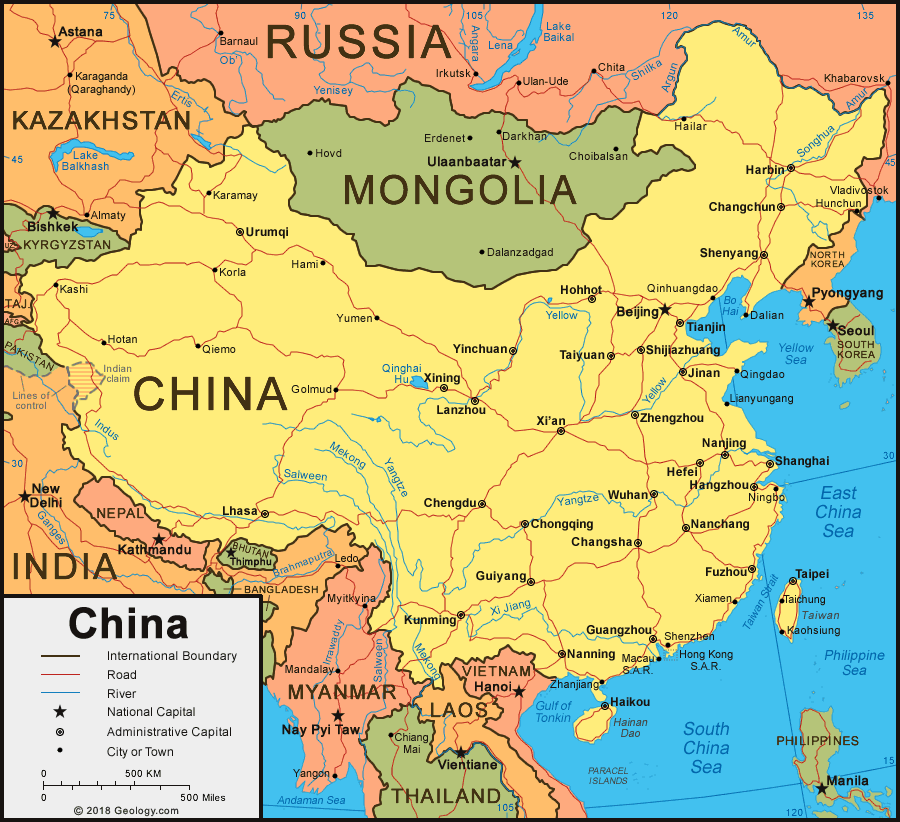
My program is based out of Kunming Nationalities University, here in Kunming. Kunming is the capital of Yunnan province, in the southwest of China. (Border countries include Vietnam, Burma/Myranmar and Laos)
Right now I'm living in a dorm with 13 other students from US universities. We will eventually be living with homestay families for two weeks, traveling northwest Yunnan together for two-weeks, and then go off and research and write independent research projects of our choice for one month.

Saturday, September 6, 2008

Chinese cuisine Xingqi Yi


Plate with the remains of Mongolian lunch. Includes what's left of the eel, duck, grasshoppers, and various other exotic culinary eats.
http://www.travelpod.com/travel-blog-entries/acdieringer/1/1220539500/tpod.html